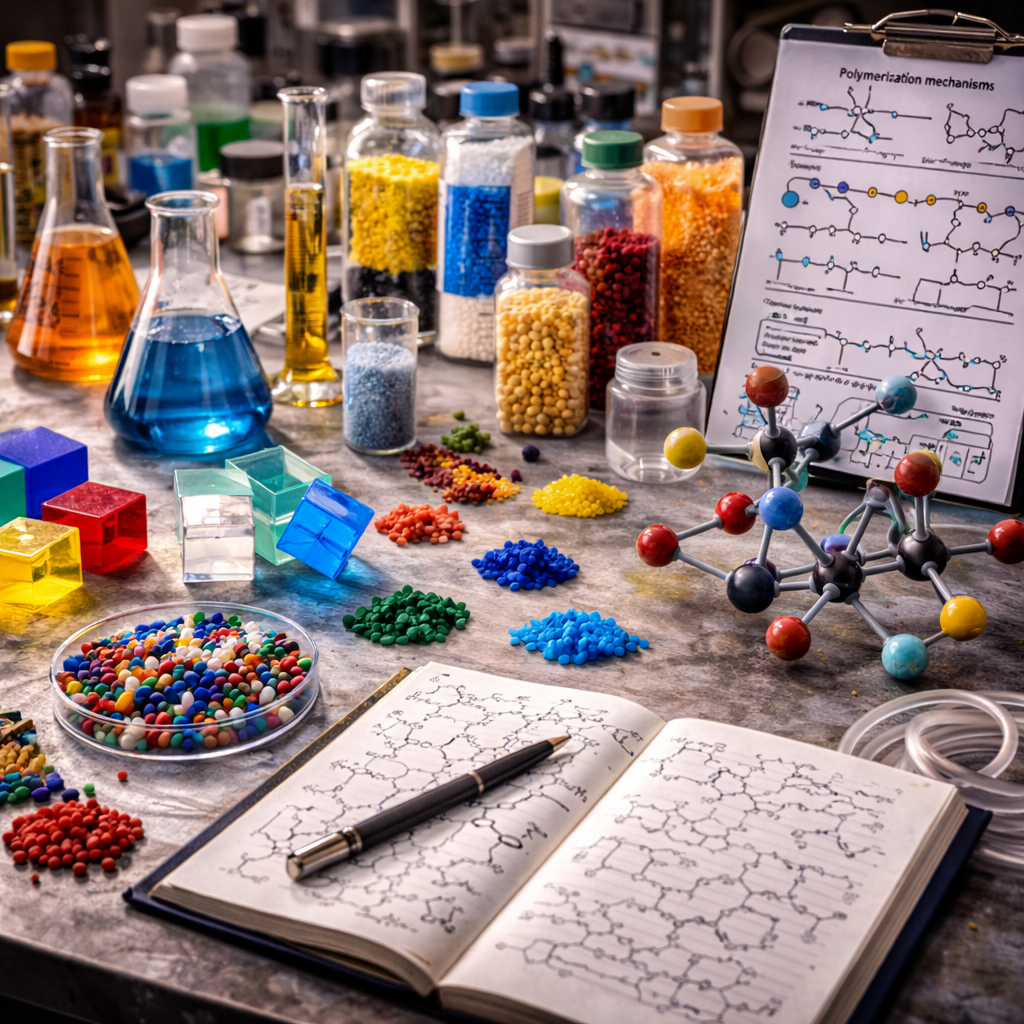
Polymer Chemistry, within the Branches of Chemistry, is the discipline focused on the synthesis, structure, properties, and behavior of polymers - macromolecules composed of repeating structural units. It encompasses both natural polymers (such as proteins, nucleic acids, and polysaccharides) and synthetic polymers (including plastics, elastomers, fibers, and advanced functional materials). Core areas include polymerization mechanisms (free-radical, ionic, coordination, step-growth, and controlled/living polymerizations), polymer architecture (linear, branched, cross-linked, block copolymers), thermomechanical behavior, rheology, self-assembly, and polymer characterization techniques (GPC, DSC, NMR, FTIR, XRD). Polymer Chemistry supports applications across materials science, biotechnology, medicine, electronics, coatings, packaging, and environmental engineering, enabling the design of materials with tailored mechanical, thermal, optical, and chemical properties. As a bridge between molecular chemistry and materials science, it provides the fundamental understanding required to engineer polymers for advanced technologies and sustainable material solutions.
Within the methodological framework of the Quantum Dictionary, Polymer Chemistry represents a domain in which terminology is deeply contextual and influenced by molecular architecture, polymerization method, material phase, and application environment. Concepts such as “chain length,” “tacticity,” “cross-linking,” “viscosity,” or “stability” collapse into distinct semantic states depending on whether they are applied in thermal analysis, mechanical testing, polymer synthesis, rheological modeling, or materials design. Variation also arises from differences in polymer class - thermoplastics, thermosets, elastomers, biopolymers - and from processing conditions such as extrusion, molding, solvent casting, or additive manufacturing. The quantum-semantic architecture encodes each polymer-science term as a contextual semantic entity whose meaning resolves according to structural domain, analytical method, functional requirement, or processing environment. This ensures semantic interoperability with adjacent fields including organic chemistry, materials science, chemical engineering, biochemistry, and nanotechnology, while preserving the definitional precision essential for materials development, performance evaluation, and technological application. By modeling the interplay among molecular structure, supramolecular organization, material properties, and processing dynamics, the Quantum Dictionary provides a coherent and adaptive lexicon aligned with the multifaceted and technologically significant nature of Polymer Chemistry.