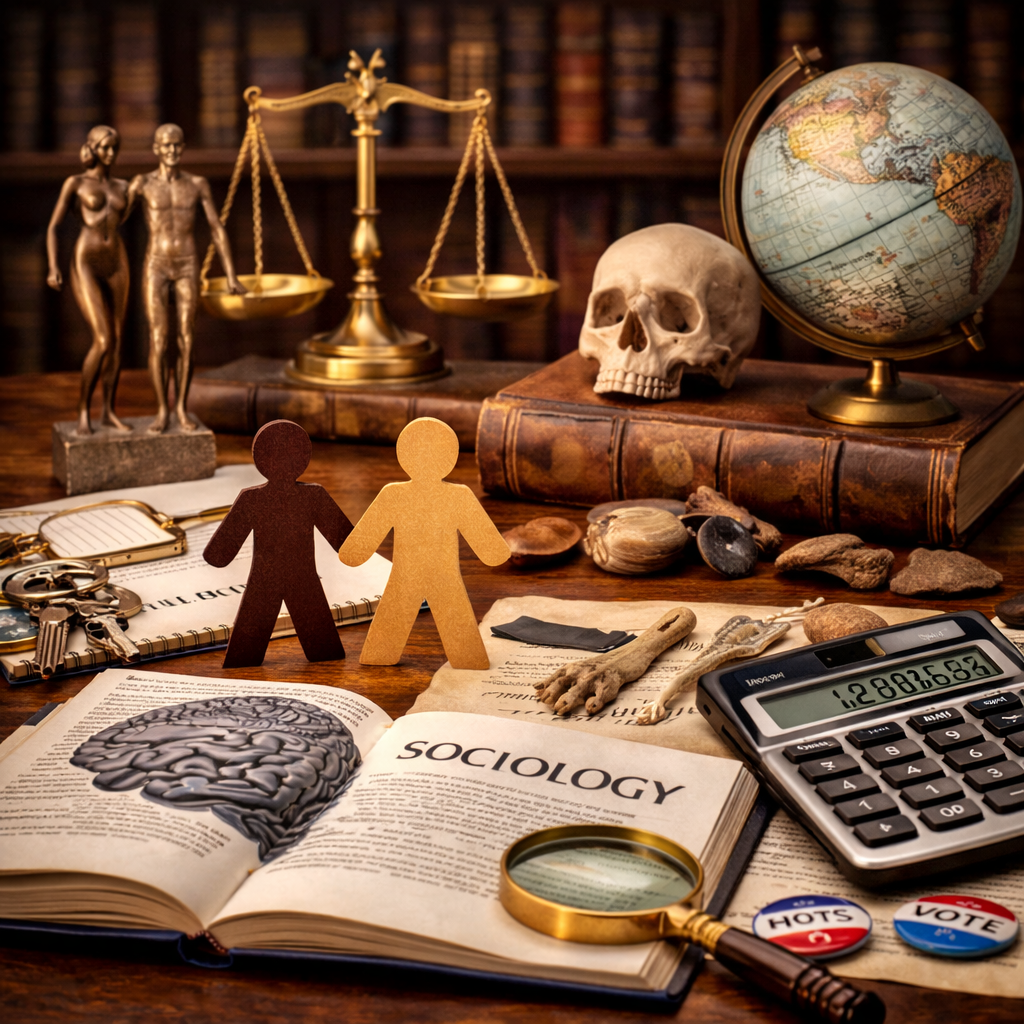
Sociology & Anthropology, within the Social Sciences, constitute a dual domain dedicated to the systematic study of human societies, cultures, institutions, behaviors, and the social forces that shape collective and individual experience. Sociology investigates social structures, group dynamics, socialization processes, inequality, institutions, deviance, demographic patterns, and the interplay between agency and social systems. It encompasses theoretical traditions such as structural functionalism, conflict theory, symbolic interactionism, and contemporary frameworks addressing globalization, technology, and social change. Anthropology complements this orientation through its holistic study of humanity across time and space, incorporating cultural anthropology, biological anthropology, linguistic anthropology, and archaeology. Cultural anthropology examines belief systems, kinship structures, rituals, material culture, and modes of social organization, while biological anthropology explores human evolution, adaptation, and biological variation. Linguistic anthropology analyzes language as a social and cultural system that encodes meaning, identity, and power. Together, Sociology & Anthropology provide an integrated understanding of human diversity, social organization, cultural meaning-making, and the long-term trajectories of human development.
Within the methodological architecture of the Quantum Dictionary, Sociology & Anthropology represent a domain distinguished by high contextual dependency, culturally contingent terminology, and interpretive pluralism. Concepts such as “culture,” “identity,” “structure,” “norms,” “ritual,” or “social capital” collapse into distinct semantic states when employed in ethnographic research, sociological theory, quantitative modeling, cross-cultural comparison, or policy analysis. Variation arises not only from methodological orientation - qualitative, quantitative, comparative, ethnographic - but also from cultural frameworks, linguistic contexts, and theoretical traditions. Terms may hold different connotations across societies, between academic subfields, or within historical periods, requiring a semantic model that can accommodate layered and situational meanings. The platform’s quantum-semantic architecture encodes each concept as a contextual semantic entity whose meaning resolves according to cultural lens, methodological approach, theoretical tradition, or empirical setting. This ensures interoperability with adjacent domains such as political science, history, linguistics, psychology, and economics while preserving the nuance essential for interpreting social behavior and cultural expression. By modeling the dynamic interplay among social systems, cultural practices, human evolution, institutional structures, and meaning-making processes, the Quantum Dictionary provides a coherent and adaptive lexicon aligned with the complex and multidimensional nature of Sociology & Anthropology.