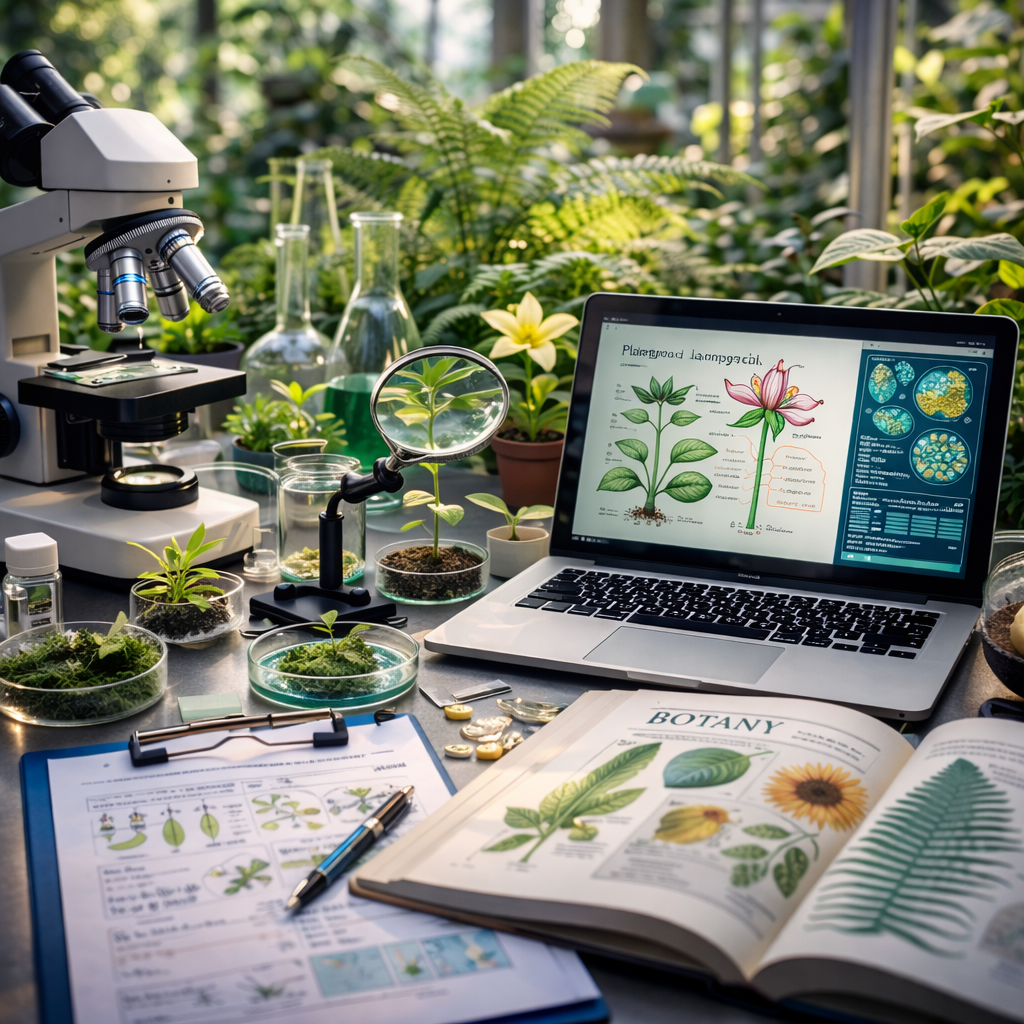
Botany, within the Specialized Fields of Biological Sciences, is the scientific study of plants, including their structure, physiology, development, reproduction, ecology, evolution, and classification. It encompasses all major plant groups - from bryophytes and ferns to gymnosperms and angiosperms - as well as algae and, in some contexts, fungi. Core areas of inquiry include plant anatomy and morphology, photosynthesis and metabolism, plant genetics, hormonal regulation, stress physiology, and reproductive biology. Botanical research extends to plant ecology, biogeography, systematics, and the evolutionary processes that shape plant diversity across ecosystems. Applied dimensions of Botany contribute to agriculture, forestry, conservation biology, biotechnology, and environmental management by informing crop improvement, habitat restoration, climate resilience strategies, and sustainable resource use. As a foundational biological discipline, Botany provides essential scientific understanding of the primary producers that support nearly all terrestrial ecosystems.
Within the methodological framework of the Quantum Dictionary, Botany represents a domain where terminology is significantly shaped by evolutionary relationships, ecological context, plant-specific physiology, and methodological approach. Terms such as “meristem,” “rhizome,” “fitness,” “stress,” or “community” collapse into distinct semantic states depending on whether they are interpreted in plant anatomy, developmental biology, evolutionary ecology, systematics, or ecosystem studies. Further variation arises from differences among plant groups, environmental conditions, and research scales - from molecular genetics to landscape-level biogeography. The platform’s quantum-semantic architecture encodes each botanical term as a contextual semantic entity whose meaning resolves according to biological scale, plant lineage, ecological setting, or analytical framework. This ensures semantic interoperability with adjacent fields including genetics, ecology, agricultural biology, biotechnology, and environmental sciences while preserving definitional precision essential for scientific research, applied management, and conservation practices. By modeling the interplay among plant structure, physiological processes, evolutionary history, and ecological dynamics, the Quantum Dictionary provides a coherent and adaptive lexicon aligned with the complexity and breadth of Botany.